Technology practitioners, newsletter authors, and intelligence analysts face severe information
fragmentation. Critical developments in artificial intelligence, cybersecurity, cloud infrastructure, and
quantum computing are dispersed across dozens of independent blogs, RSS feeds, and technical news wires.
Standard RSS readers often lack fast full-text historical search, introduce heavy visual clutter, and
require cumbersome manual copy-pasting to format citations for Substack articles or research dossiers.
The objective was to design a focused, local-first intelligence hub that ingests, indexes, and organizes
multi-category technical reporting with sub-millisecond retrieval and single-click citation generation.
The Solution & Technical Highlights
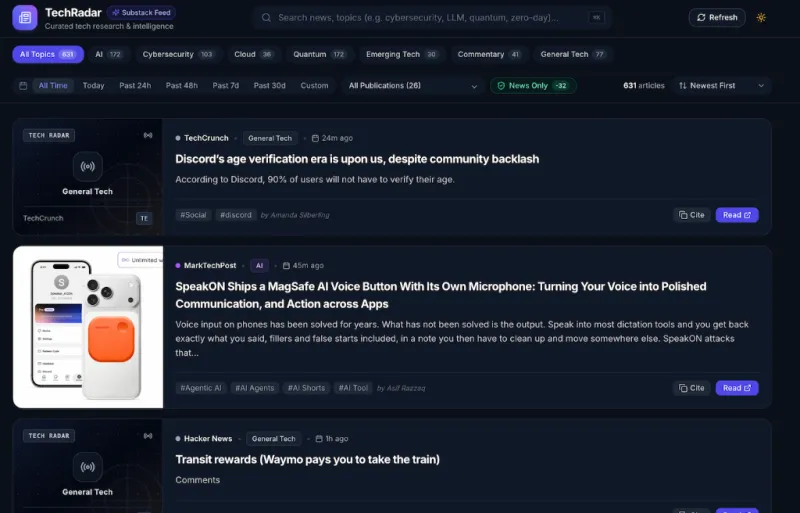
High-Density Multi-Domain Ingestion
Engineered an asynchronous Python background fetcher that aggregates feeds across 7 dedicated sectors
(AI, Cybersecurity, Cloud, Quantum, Emerging Tech, Tech Commentary, and General Tech) with automated
thumbnail extraction, HTML sanitization, and timestamp normalization.
Sub-Millisecond SQLite FTS5 Search
Implemented local SQLite storage accelerated by FTS5 (Full-Text Search) virtual tables, enabling
instantaneous keyword matching with keyboard activation (⌘K or /) across large
article libraries without third-party SaaS indexing fees or external latency.
1-Click Substack Citation Generator
Built a dedicated citation export engine that pre-formats article headlines, canonical links, and source
publication attributions directly into clean Markdown format copied to the clipboard for instant
pasting into Substack and markdown-based editorial drafts.
Intelligent Research Curation Pipeline
Integrated an optional Google Gemini AI pipeline that extracts named entities (companies, protocols,
CVE identifiers) into filterable badges and automatically clusters related stories when multiple
outlets report on the same breaking industry event.
Reactive High-Density User Interface
Designed a streamlined single-page dashboard with React and Tailwind CSS featuring dynamic category
pills, quick date presets (24h, 48h, 7d, 30d), outlet filters, and stacked high-information cards.
Key Outcomes & Impact
Accelerated technical newsletter curation cycles by over 75%, reducing the time needed to review,
cross-reference, and cite authoritative sources from several hours to minutes.
Eliminated recurring SaaS feed aggregator and search platform costs through a lightweight, zero-maintenance
local-first architecture.
Standardized editorial citations across research publications with single-click clipboard exports,
preventing broken links and missing source attributions.
Enhanced cross-outlet perspective detection via automated story clustering, allowing researchers to
quickly compare coverage angles on breaking technological and cybersecurity disclosures.